Note
Go to the end to download the full example code.
How to use this material
This material is part of a 6-8 hour learning module with a 2 hour instructor-led session in the middle. Here’s how to approach it:
Before class: Watch the videos to understand the SIR model concept and read through the equation derivations. Set up Python on your computer or use Google Colab. Download the Jupyter notebook or Python code from the links at the bottom of this page and run the examples, experimenting with different β and γ values.
During class: Your instructor will guide you through the mathematical foundations and help you interpret phase planes and nullclines. This is your opportunity to ask questions and deepen your understanding of epidemic dynamics.
After class: Work through the parameter exploration exercises and practice using the model to predict outbreak peaks and evaluate interventions. Submit your completed work to your instructor as directed.
What you will learn
Preamble: Imagine a new virus emerges in your community. At first, only a few people are infected but soon hospitals in your city begin to fill up.
You are asked a critical question: Can we predict when this outbreak will be at it’s peak, how many people will get infected, and what interventions could stop it?
Did you know that ordinary differential equations (ODEs) are not abstract math but a tool for saving lives in a case like this?
These questions can be answered using the SIR model. The Susceptible Infected Recovered (SIR) model can be described using three differential equations.
But, can these ordinary differential equations really describe the story of an outbreak from start to end?
In the video above , Patience answers this question as she takes us through the mathematical foundations of the SIR model often referred to as The Math of Epidemics.
She explains the total population(N) which consists of 3 populations of individuals often referred to as compartments of the SIR model. The susceptible(S) are the individuals at an increased risk of infection and may require interventions such as vaccination or chemoprophylaxis, social distancing etc, to prevent diseases. These do not have the virus but could catch it. The Infected/Infectious(I) are the people who have the virus and can spread it to those who are susceptible and the Recovered(R) are the people who have had the virus, have recovered, and can no longer spread it.
She also explains two key variables; β which is the disease transmission rate and γ which is the recovery rate
The SIR model operates on 4 assumptions:
The total population N is constant in time. No births, deaths or migration
There is a homogeneous mixing of the infected and susceptible populations
Individuals who recover from the disease gain permanent immunity
Both the rate of Infection and the rate of recovery are constant
You should now have a solid understanding of the SIR model at a conceptual level. In the next video, we’ll translate those ideas into differential equations, allowing us to analyze and simulate how epidemics evolve.
Deriving the Equations
In the video, Patience described the three compartment of the SIR model as the susceptible, infected and recovered groups. Where the number of Susceptible individual at time \(t\) is represented as \(S(t)\); the number of infected individuals as \(I(t)\) and the number of recovered individuals is \(R(t)\).
Also, in the SIR model, we assume that the disease is spread through contact between susceptible and infected individuals and that a recovered individual developed immunity to the disease. We also assume that the population is closed, meaning that there are no births, deaths or migration. Meaning that if N is the total population, then at any time \(t\), we have \(S(t) + I(t) + R(t) = N\).
Thats a lot of assumptions right? I agree, but hang on, it will all come together after we derive the equations.
However, we still need to define few extra things we will need.
Let’s define \(\beta\) as the transmission rate, which represents the rate at which susceptible individuals become infected through contact with infected individuals. and,
\(\gamma\) as the recovery rate, which represents the rate at which infected individuals recover from the disease and move to the recovered compartment.
Now that we have these definitions, we can start deriving the equations.
To get concerned about an infectious disease spreading, there must have been someone infected,else there is no point of doing all this, therefore we assume \(I > 0\). Also, the number of people infected would increase the chances of a susceptible individual coming into contact with an infected individual. Therefore, we can calculate the number of susceptible indiviudals that will get infected as follows:
Also, the number of recovered individuals can be calculated as follows:
Now we can estimate the change in each of the groups. To achieve this, we will take the different between the number of individual entering a compartment and the number that is leaving the compartment. lets represent this number as:
\(\frac{dS}{dt}\) for the subsceptible group,
\(\frac{dI}{dt}\) for the infected group and,
\(\frac{dR}{dt}\) for the recovered group. We will have the following equations:
Since no individual is entering the subsceptible group.
The out in (3) is zero since we assume individuals that have recovered from the disease develop immunity and cannot be infected again.
While it is very important to understand this math, python makes it easier for us to solve these equations by importing key python libraries without having to manually do these calculations.
Let’s now solve these equations numerically in python. We start by importing the libraries we need from Python.
import numpy as np
import matplotlib.pyplot as plt
import matplotlib
from pylab import rcParams
matplotlib.font_manager.FontProperties(family='Helvetica',size=11)
rcParams['figure.figsize'] = 9/2.54, 9/2.54
from scipy import integrate
Now we define the model. This code creates a function which we can use to simulate differential equations (1) and (2). We also define the parameter values β (the infection rate) and γ (the recovery rate. You can change these to see how changes to the paramaters leads to changes in the outcome of the model.
# Parameter values
beta = 1/2
gamma = 1/7

# Differential equation
def dXdt(X, t=0):
    return np.array([  - beta*X[0]*X[1] ,              #Susceptible X[0] is S
                      beta*X[0]*X[1]   - gamma*X[1],       #Infectives X[1] is I
                      gamma*X[1]])                      #Recovered X[2] is R
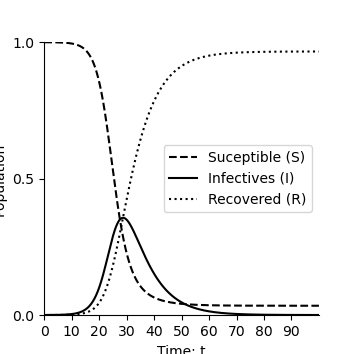
Let’s now solve these equations numerically and plot the solution over time. You can change β to see how changes to the parameters leads to changes in the epidemic curve. Let’s try it here by changing β values and observe the changes over time.
def plotEpidemicOverTime(ax,t,S,I,R):

    ax.plot(t, S, '--',color='k', label='Suceptible (S)')
    ax.plot(t, I  , '-',color='k', label='Infectives (I)')
    ax.plot(t, R  , ':',color='k', label='Recovered (R)')
    ax.legend(loc='best')
    ax.set_xlabel('Time: t')
    ax.set_ylabel('Population')
    ax.spines['top'].set_visible(False)
    ax.spines['right'].set_visible(False)
    ax.set_xticks(np.arange(0,100,step=10))
    ax.set_yticks(np.arange(0,1.01,step=0.5))
    ax.set_xlim(0,100)
    ax.set_ylim(0,1)


t = np.linspace(0, 100,  1000)               # time
X0 = np.array([0.9999, 0.0001,0.0000])      # initially 99.99% are uninfected
X = integrate.odeint(dXdt, X0, t)           # uses a Python package to simulate the interactions
S, I, R = X.T
fig,ax=plt.subplots(num=1)
plotEpidemicOverTime(ax,t,S,I,R)
plt.show()
Phase Planes and nullclines
In this section, Emily introduces the concept of phase planes and nullclines in the video below, using the SIR model as an example.
The material that follows recaps what is covered in the video, with supporting code and explanations to help you explore phase planes for yourself.
What are Phase Planes, and Why Do We Use Them?
A phase plane is a graphical representation of a dynamical system i.e a system described by differential equations where we plot one variable against another instead of plotting them over time. Phase planes provide a powerful visualization method for dynamic systems.
Why a dynamic system? In mathematics and epidemiology, a dynamic system means a set of linked equations that describe how variables change over time. So the SIR model is a dynamic system because the numbers of S,I and R are continuously changing as the epidemic evolves i.e When there are many susceptibles and few infected, the rate of infection is high, as susceptibles decrease, the rate of infection slows down and when almost everyone is recovered, the infection fades away. The trajectory of the epidemic (rise, peak, decline) is a dynamic response to how the parts of the system interact over time Instead of observing each variable separately over time, phase planes plot one variable against another. In our case, a common representation for the SIR model is the interaction between the Susceptible (S) and Infected (I) groups. This is used both in in Emily’s video, and further below in the code examples.
This visualization allows us to better understand complex system behaviors, such as:
The spread of disease over time
Stabilization points (equilibrium)
The eventual decline or extinction of an epidemic
Phase planes highlight crucial relationships, equilibrium points, and system behavior that can inform predictions about the long-term outcomes of an epidemic.
Key Components of Phase Planes
To fully understand phase planes, let’s examine their key components:
- Axes:
The axes of a phase plane represent the system variables, which is Susceptible (S) and Infected (I) in this case. By plotting one variable against another, we can see how these groups interact directly, rather than just observing their individual changes over time.
- Trajectories:
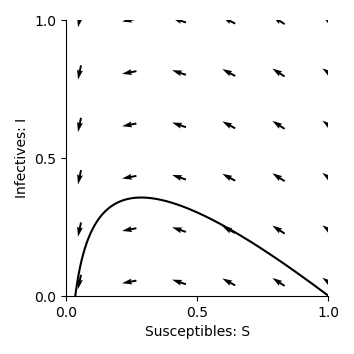
Trajectories portray the state of the system as it evolves. For the SIR model in particular, the trajectory describes how the numbers of susceptible and infected individuals change in relation to one another as the epidemic progresses over time.
- Directional Arrows:
These arrows on the phase plane indicate the direction of movement over time, showing how the system transitions between states. They guide us through the epidemic’s progression, pointing from higher susceptibility toward states of greater infection or recovery.
Below is the first example of a phase plane showing how the SIR system evolves over time, with Susceptible (S) on the x-axis and Infected (I) on the y-axis.
beta = 1/2
gamma = 1/7

def plotPhasePlane(ax,S,I):
    ax.plot(S, I, '-',color='k')
    ax.set_xlabel('Susceptibles: S')
    ax.set_ylabel('Infectives: I')
    ax.spines['top'].set_visible(False)
    ax.spines['right'].set_visible(False)
    ax.set_xticks(np.arange(0,1.01,step=0.5))
    ax.set_yticks(np.arange(0,1.01,step=0.5))
    ax.set_ylim(0,1)
    ax.set_xlim(0,1)

def drawArrows(ax,dXdt):
    x = np.linspace(0.05, 1 ,6)
    y = np.linspace(0.05, 1, 6)
    X , Y  = np.meshgrid(x, y)
    dX, dY, dZ = dXdt([X, Y,1-X-Y])
    #Make in to unit vectors.
    M = np.hypot(dX,dY)
    dX = dX/M
    dY = dY/M
    ax.quiver(X, Y, dX, dY, pivot='mid')

fig,ax=plt.subplots(num=1)
plotPhasePlane(ax,S,I)
drawArrows(ax,dXdt)
plt.tight_layout()
plt.show()
Equilibrium Points and Nullclines
One essential element of phase planes is the determination of equilibrium points. These points occur where the rates of change for both Susceptible (S) and Infected (I) are zero. The lines where the rate of change of a variable is equal to zero are called nullclines. The intersection of these nullclines determines the equilibrium points, which are crucial to understanding how an epidemic evolves. As the system evolves, either the susceptibles (S) becomes zero or the Infected(I) become zero and the point at which they intersect where S=0 (vertical axis) and I=0(horizontal axis) is the equilibrium. This is the S-nullcline. The I-nullcline is where I=0 or βS- γ = 0 and if we make S the subject, then S=γ/β So the I-nullclines are I=0(horizontal axis) and S=γ/β (vertical axis)
S=γ/β is very important because it represents the threshold for the outbreak. This is also referred to as the R_o (basic reproductive number/ratio).
Similar to the predator prey model, we can find the equilibria for the infected population, where the rate at which people become infected equals the rate at which they recover. This is done by solving:
This occurs either when \(I=0\) (no one has the disease) or when \(S=\gamma/\beta\).
For the susceptible population:
which simplifies to \(I = 0\) or \(S = 0\). These resultant values are all nullclines of this system.
We can now plot the nullcline \(S=\gamma/\beta\) on the phase plane:
import numpy as np
import matplotlib.pyplot as plt
from scipy.integrate import odeint

# Parameters
beta = 1/2
gamma = 1/7

# Integrate the system
t = np.linspace(0, 100, 1000)
X0 = np.array([0.9999, 0.0001, 0.0000])
X = integrate.odeint(dXdt, X0, t)
S, I, R = X.T

fig,ax=plt.subplots(num=1)
# Include nullcline
ax.plot([gamma/beta,gamma/beta],[-100,100],linestyle=':',color='k')
plotPhasePlane(ax,S,I)
drawArrows(ax,dXdt)
plt.tight_layout()
plt.show()
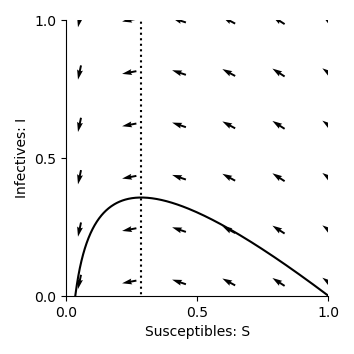
Now, we can see that this nullcline passes through the trajectory at its peak. This is because the rate of change of infections (\(\frac{dI}{dt}\)) becomes zero when \(S=\gamma/\beta\), and the number of infected individuals reaches the maximum value possible for the system. This visual insight helps us understand how the number of infections evolves over time, and the nullclines highlight important thresholds in disease spread. The effects of interventions, such as vaccination or changes in contact rates can also be visualised in this way, by showing how they might shift the trajectory or alter the nullclines.
Impact of Parameters
Now, we can investigate what happens to the phase planes when we change the values of \(\beta\) and \(\gamma\). In our previous code examples, the \(\beta\) value was \(\frac{1}{2}\), which is the rate of contact between people, or transmission rate. What do you think will happen to the phase plane trajectory if we increase this value? How will the nullcline be impacted? You can change the “beta” value in the code block to test your hypothesis.
Answer:
As \(\beta\) increases, the infection rate becomes faster, which means the disease spreads more quickly. This leads to a faster rise in the number of infected individuals, and the trajectory in the phase plane will become steeper. The peak of the trajectory will also become higher, as more individuals get infected more quickly before reaching the recovery phase.
The nullcline, which represents the point where the rate of change of infected individuals is zero (i.e., where the number of infections and recoveries are balanced), shifts to the left as \(\beta\) increases. This indicates that, for a higher transmission rate, fewer susceptible individuals remain in the population when the epidemic reaches equilibrium. Essentially, a larger number of people are infected earlier, so there are fewer susceptible individuals left when the system reaches a stable state.
Similarly, the \(\gamma\) value was set to \(\frac{1}{7}\), representing the recovery rate. What happens to the trajectory and nullcline for the phase plane when this value is increased?
Answer:
A flatter trajectory and a lower peak (due to quicker recovery) will be observed. In addition, the nullcline shifts to the right, indicating a higher number of susceptible individuals at equilibrium.
This is because the quicker recovery of individuals causes the epidemic to peak and decline more quickly, leaving a larger proportion of the population susceptible at the point of equilibrium.
SIR Exercise
(Please NOTE that the SEIR chapter that follows this SIR chapter is optional, and the associated questions do not need to be formally submitted.)
When a high \(\gamma\) or low \(\beta\) value is used, the trajectory does not return to the x-axis after peaking. Why might this be happening?
We have been initialising the models with 99.99% of the population as susceptible, and only 0.01% infected. How are the phase planes affected when changing this proportion?
If we could reduce the Infection/transmission rate β (e.g., through social distancing or vaccination), what do you think will happen to the nullcline? Then how would the epidemic curve change? What if this value increases?
If we could increase recovery rate γ, how would the curve change?
If we reduced β while at the same time increasing γ how would that alter the shape of the epidemic curve?
How can we estimate how long it will take for the epidemic to be at its peak and how long it will stay at its peak? This question is answered using phase planes and nullclines in Emily’s video
How can the SIR model help governments decide when to lift restrictions?
Can you now be able to answer the question you were asked at the start i.e Can we predict when this outbreak will be at it’s peak, how many people will get infected, and what interventions could stop it?
YOU CAN SUBMIT YOUR ASSIGNMENT HERE
Total running time of the script: (0 minutes 1.631 seconds)